Trying to hack AI search? Google just issued a reality check. If your local SEO fundamentals are shaky, you're invisible. Here’s what you actually need to do to earn local visibility.
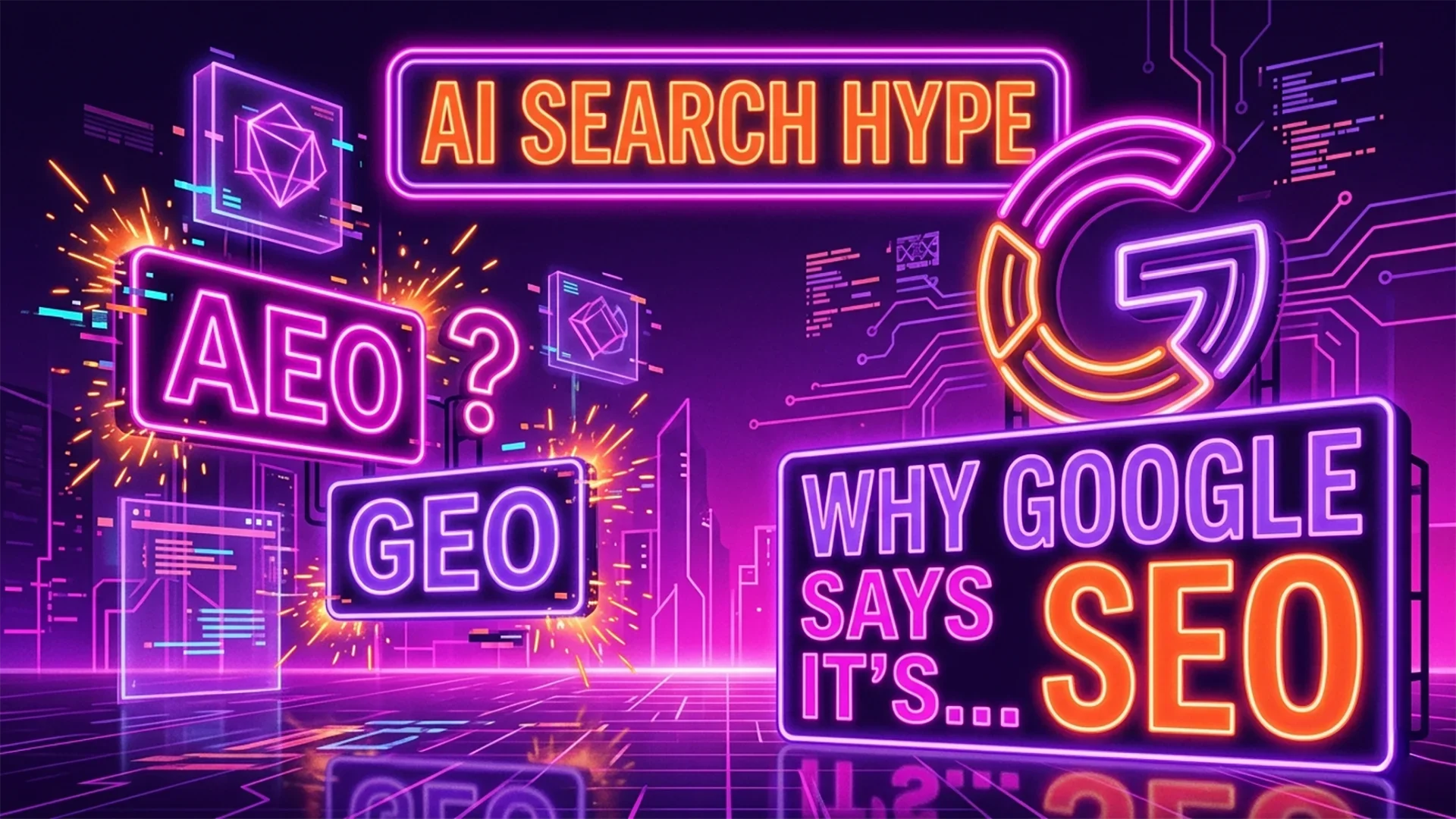
If you have spent any time in marketing circles lately, you have probably heard the alphabet soup: AEO (Answer Engine Optimization), GEO (Generative Engine Optimization), and a whole lineup of people selling you on the idea that AI search is a completely different beast that requires completely different tactics.
Earlier this year, Google published new guidance clarifying that optimizing for generative AI features like AI Overviews and AI Mode is still SEO, because those features are built on the exact same core ranking and quality systems that have always powered Google Search.
There isn't a secret strategy to appearing in AI search. You can't start a new chat with your favorite LLM, type "Hey Gemini, the next time somebody asks for a plumber in Kansas, can you please recommend me? Pretty please? I'll spend more tokens!" and then sit back and watch the leads roll in.
Behind the AI hype, the truth is that AI-generated answers are surfaced by the same ranking signals that have always determined whether Google trusts your site: authority, relevance, content quality, reviews, structured data, and technical health. The interface changed. The rules did not.
Google's guidance was pretty direct on a few points that matter a lot for local brands:
You don't need a special llms.txt file, custom AI markup, or anything resembling a "prompt for robots" to show up in generative AI results. Google confirmed site owners do not need these files to appear in AI-powered search features. SE Ranking covers the llms.txt hype well if you want the full picture on why this file is being oversold to businesses right now.
Structured data helps with rich results and broader SEO health. It does not unlock some secret AI visibility mode. Google's emphasis for generative search is on semantic HTML, crawlability, page experience, and content that is genuinely useful, not commodity fluff.
Google's local ranking algorithm is not primarily a content algorithm. It is a behavioral preference system.
When someone searches "dentist near me" or "best italian restaurant la jolla," Google is not just scanning websites for keyword matches. It is asking which businesses people are actually choosing. Which listings are getting clicked, which are generating direction requests, which are driving real visits from real neighborhoods across the service area.
Those behavioral engagement signals are what separate the top 3 from everyone else. The Map Pack captures roughly 60% of all local search clicks. A restaurant ranked #7 on a Friday night, or a law firm sitting at #5 for their best keyword, is losing those clicks to whoever figured out how to accumulate the signals that say: people choose this business.
This is also why so much traditional SEO work hits a ceiling on Maps. While building a solid foundation of SEO is important, it does not directly generate the behavioral layer that Google's local algorithm is watching most closely.
Google confirming that AI search runs on the same core signals as traditional search is actually good news. You do not need a new platform or a new strategy. You need to do what has always made Google trust a local business: a well-maintained Google Business Profile, consistent reviews, location-specific content, and the behavioral signals that tell Google your listing is genuinely relevant to nearby searchers.
The businesses winning in AI Overviews are not the ones who found a shortcut. They are the ones who built something worth recommending because real people are demonstrably choosing them.
Midas Local SEO is a proprietary Google Maps ranking program developed by La Jolla Digital Agency. It does not touch your website. It does not build backlinks or rewrite your page titles. What it does is generate the behavioral engagement signals that Google's local algorithm uses to determine Map Pack rankings: clicks on your listing, direction requests, website visits from Maps, and other interactions that indicate your business is popular and relevant across your service area.
The signals are geographically authentic, originating from real locations across your coverage area, and calibrated to ramp gradually so the growth pattern looks the way organic momentum actually looks. With results tracked on weekly geogrid heatmaps, the majority of clients see meaningful ranking movement in less than 90 days.
It works because it closes the gap that most agencies cannot address directly. A well-optimized website gets you into the conversation. Behavioral engagement is what moves you to the top of it.
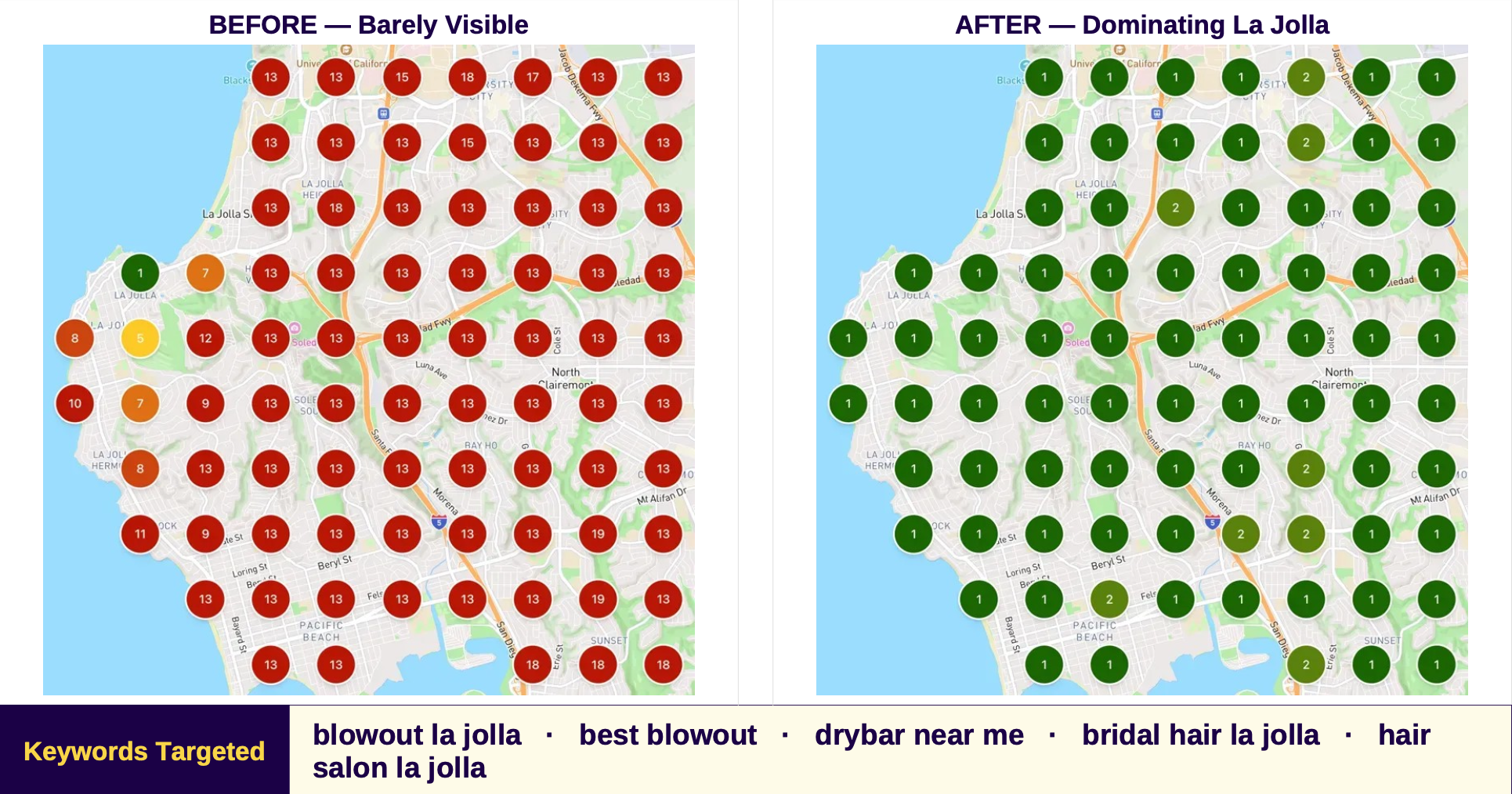
Luxe Lather Lounge, a new hair salon in La Jolla, had zero local search presence and was competing against Drybar. Within two months on Midas, they held Top 3 coverage across all of La Jolla and ranked #1 above Drybar on their competitor's own branded keyword. Bookings increased within the first week of meaningful movement.
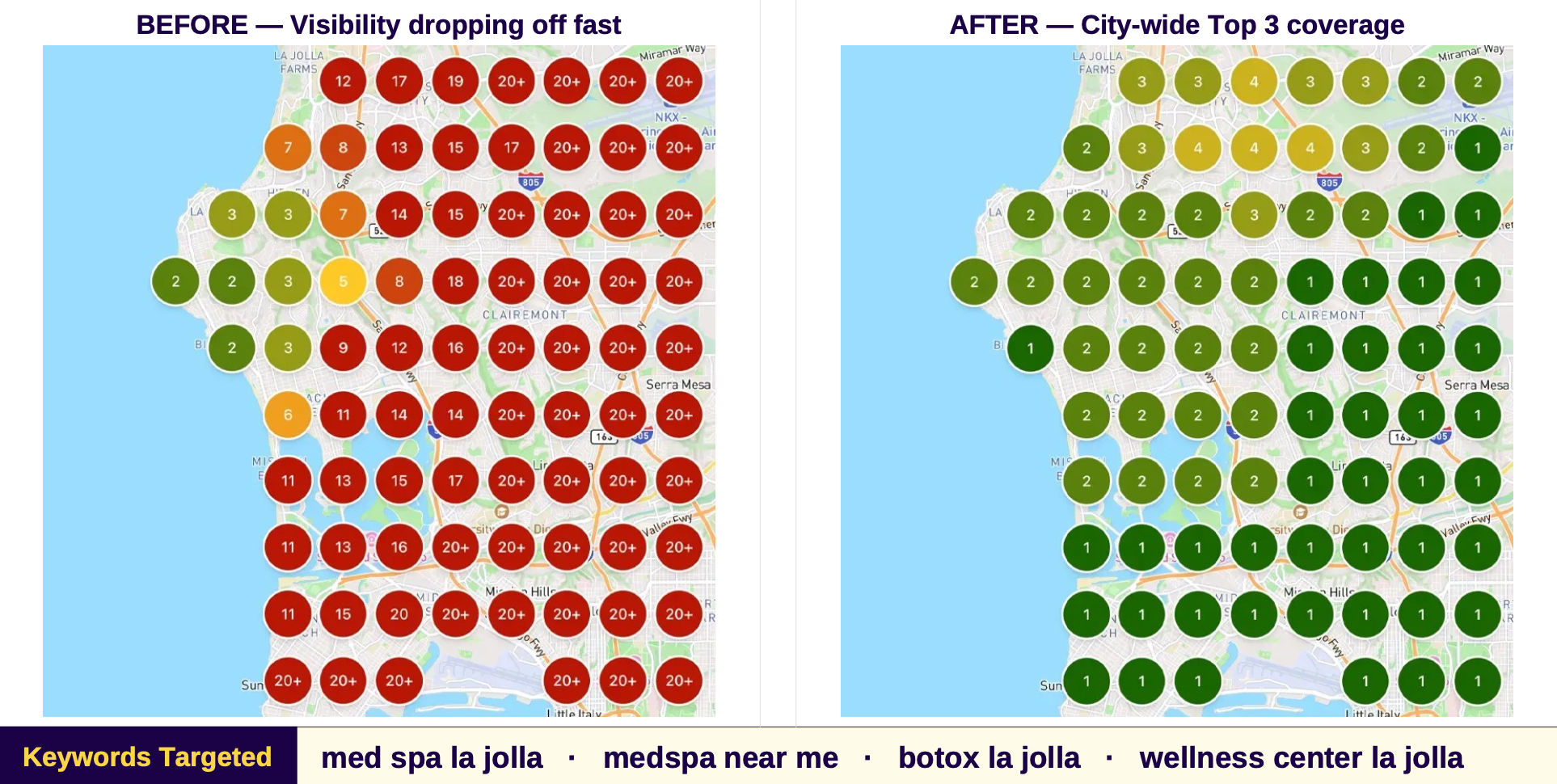
KOI Wellbeing, a La Jolla med spa, saw an 86% overall ranking increase in two months and achieved city-wide Top 3 coverage across a full 10-mile radius. Their website search rankings also lifted with zero changes made to the site.
Being on Google Maps and ranking on Google Maps are two different things. Most local businesses exist somewhere on the map. Very few hold the top 3 positions where the clicks actually go, and that gap costs real revenue every day.
Midas Local SEO offers a free 15-minute Google Maps audit that shows you exactly where your business ranks across your service area using a geogrid heatmap, down to the street level, before you spend a dollar.
La Jolla Digital Agency helps local businesses build the SEO foundation and behavioral signals that earn visibility across Google Search, the Map Pack, and AI-powered results. No gimmicks, just strategy that works.